Buying a character home in the Wye Valley or the Vale of Usk is one of the best decisions you can make, and one of the easiest to get wrong. Stone walls, slate roofs and river views come with private drains, old rights of way and planning rules that most town buyers have never met. This guide walks you through all of it, so you can fall in love with a house and still buy it with your eyes open.
How to use this guide. Read it once before you start viewing, then come back to the checklist at the end before you make an offer. Each section points you to a deeper Tŷ Hir guide where one exists. Nothing here replaces advice from your own solicitor, surveyor, mortgage adviser or tax adviser, but it will help you ask them the right questions.
The valley and the vale: where to look
Two rivers shape this corner of the border country, and each gives its homes a different feel.
The Vale of Usk is broad, green and gentle: rolling farmland, small market towns and villages strung along the river. Usk, Raglan and Caerleon are the anchors. Homes here tend to be stone farmhouses, cottages, converted barns and chapels, often with land, and the M4 and Newport are close enough for commuters.
The Wye Valley is steeper and more dramatic: wooded gorges, limestone cliffs and the river winding from Monmouth down past Tintern to Chepstow. Much of it sits within the Wye Valley National Landscape (formerly an Area of Outstanding Natural Beauty). Expect cottages clinging to hillsides, riverside houses and grand country homes, with tight village plots and spectacular views.
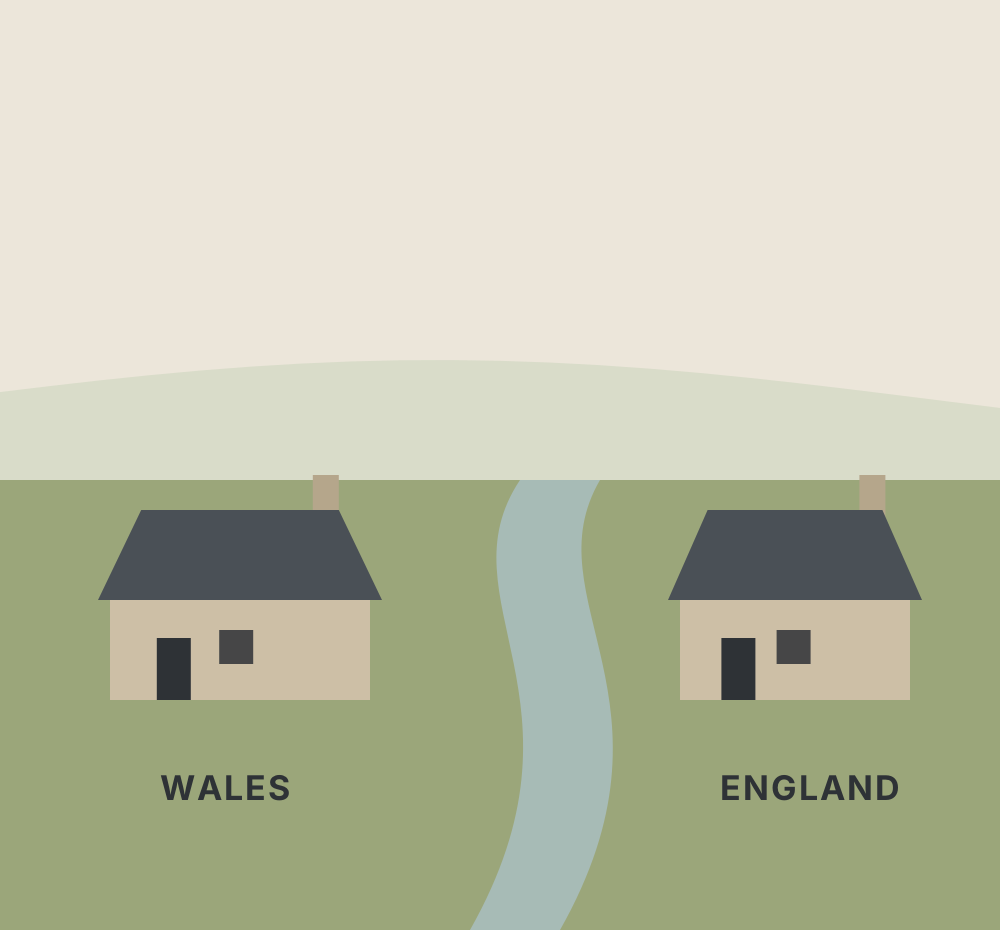
The border runs down the river. Below Monmouth, the Wye forms the boundary between Wales and England. A house on the western bank is in Monmouthshire, Wales; one on the eastern bank may be in Gloucestershire or Herefordshire, England. The view may be identical, but the tax you pay on purchase, the planning rules and the tenancy law are not. Always confirm which side of the line a property sits before you do your sums.
What counts as a character home
Character homes in the Wye Valley and the Vale of Usk span several centuries and several ways of life. Many began as working buildings: farmhouses, barns, mills and chapels built from local sandstone and limestone, roofed in Welsh slate or stone tiles, and adapted by every generation that lived in them. That history is a large part of their charm, and it is also the reason each type comes with its own set of questions.
The table below sets out the types you'll see most often on the market here, and the key things to watch for with each.
| Type | Key things to watch for |
|---|---|
| Longhouse (tŷ hir) | The traditional Welsh longhouse housed people at one end and animals at the other, under one long roof. Most were converted into a single home long ago, so check that the former byre end was converted with any necessary consents and meets building regulations. Thick stone walls built without a damp-proof course need to breathe, so look closely at how damp, ventilation and any modern renders or plasters have been handled. |
| Stone farmhouse | Farmhouses often come with outbuildings, yards and land, which is much of their appeal. Confirm exactly what is included in the sale, whether any land is let to a farmer or tied into grazing agreements, environmental schemes or rights for others, and whether the outbuildings are structurally sound. Older farmhouses may also share drainage, water or access with neighbouring farms. |
| Barn conversion | Barn conversions offer volume, exposed beams and large windows, but their history matters. Check that the conversion had full planning permission and building regulations sign-off, and whether any planning condition restricts how it can be used, for example as a holiday let only. Look carefully at insulation, heating costs and how the original structure has been adapted, since barns were never designed to be lived in. |
| Chapel conversion | Former chapels bring height, arched windows and a building with a story. Some still have graves on site, and relatives may have the right to visit them, so ask early. Check for covenants imposed when the chapel was sold, restrictions on alterations if it is listed, and practical matters such as parking, heating a tall space, and the condition of the roof and windows. |
| Cottage | Cottages are often the most affordable way into village life, but their size and age may bring compromises. Watch for low ceilings and doorways, steep stairs, small rooms and limited parking. Many cottages in terraces or close-knit village streets share walls, drains or paths with neighbours, so make sure any shared arrangements are properly documented. |
| Country house | Larger period houses offer grandeur and grounds, with running costs and maintenance on the same scale. Many are listed, which affects what you can change and how. Budget realistically for heating, roofs, stonework, and the upkeep of gardens and woodland, and check for public rights of way, shared drives, or tenancies attached to any cottages on the estate. |
Whatever type of home you fall for, the same principle applies: the older and more unusual the building, the more its history and paperwork matter. The next three sections explain what to check.
The rural checks
Town houses plug into mains services and sit on neatly mapped plots. Many rural homes do neither. These are the checks that matter most.
Drainage
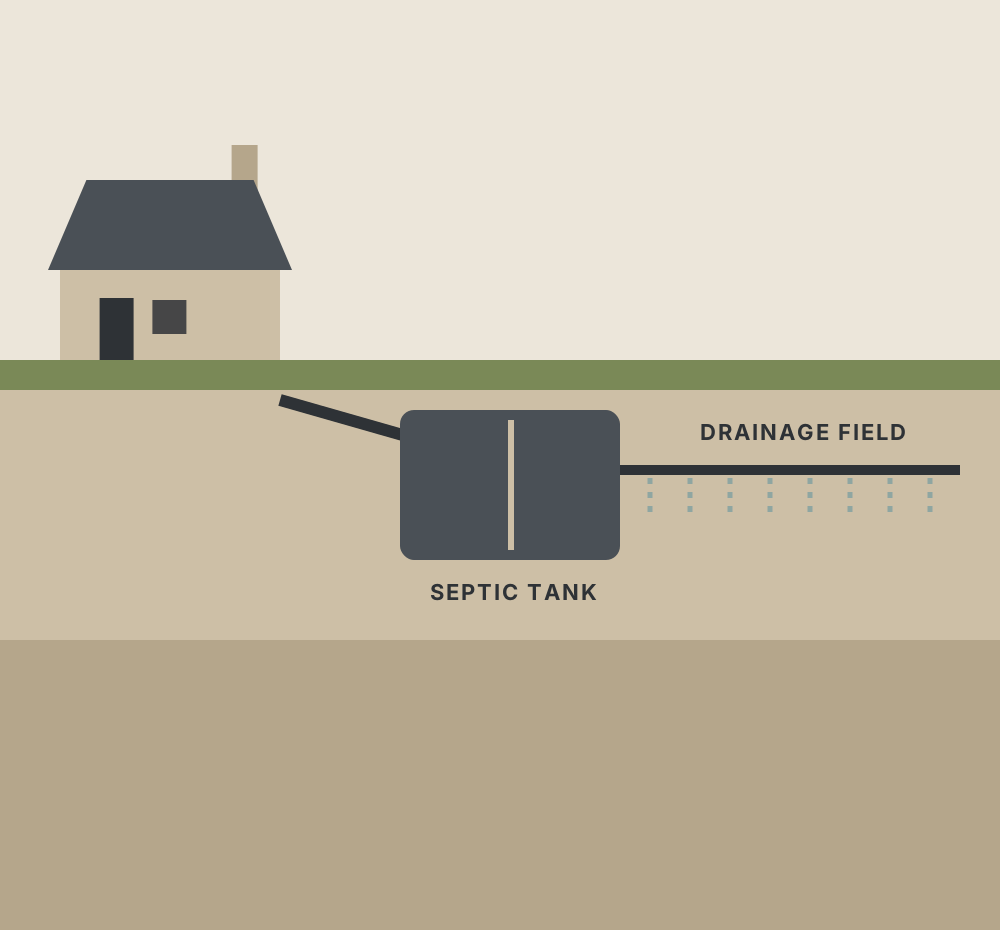
If a home isn't on mains sewerage, it will have a septic tank, a small sewage treatment plant or, occasionally, a cesspit. The rules differ either side of the border. In Wales, septic tanks and small treatment plants must be registered with Natural Resources Wales (NRW), although in most cases registration is a simple, one-off process that costs nothing (NRW). In England there is no registration, but systems must meet the Environment Agency's general binding rules, and a septic tank can no longer discharge straight into a stream or ditch.
Ask the seller for the registration (in Wales), the date and type of the system, where the tank and drainage field sit (sometimes on a neighbour's land), whether the system is shared, and the emptying and maintenance records. NRW expects owners to keep records for five years and tell buyers in writing that a system exists (NRW). A drainage survey is money well spent; replacing a failed system can cost many thousands of pounds.
Water supply
Some homes draw their water from a private spring, well or borehole rather than the mains. A private supply can be excellent, and many owners swear by the taste, but keeping it safe becomes your responsibility. Local councils regulate private supplies and can sample and test them, and supplies that serve more than one home, or a holiday let, are usually checked on a regular schedule.
Before you buy, ask for recent water test results and details of any treatment, such as filters or an ultraviolet unit, and find out how reliable the supply has been in dry summers. If the source or the pipes sit on someone else's land, your solicitor should check that you have the legal right to reach, use and maintain them, and whether you share the supply and its costs with neighbours.
Access and rights of way
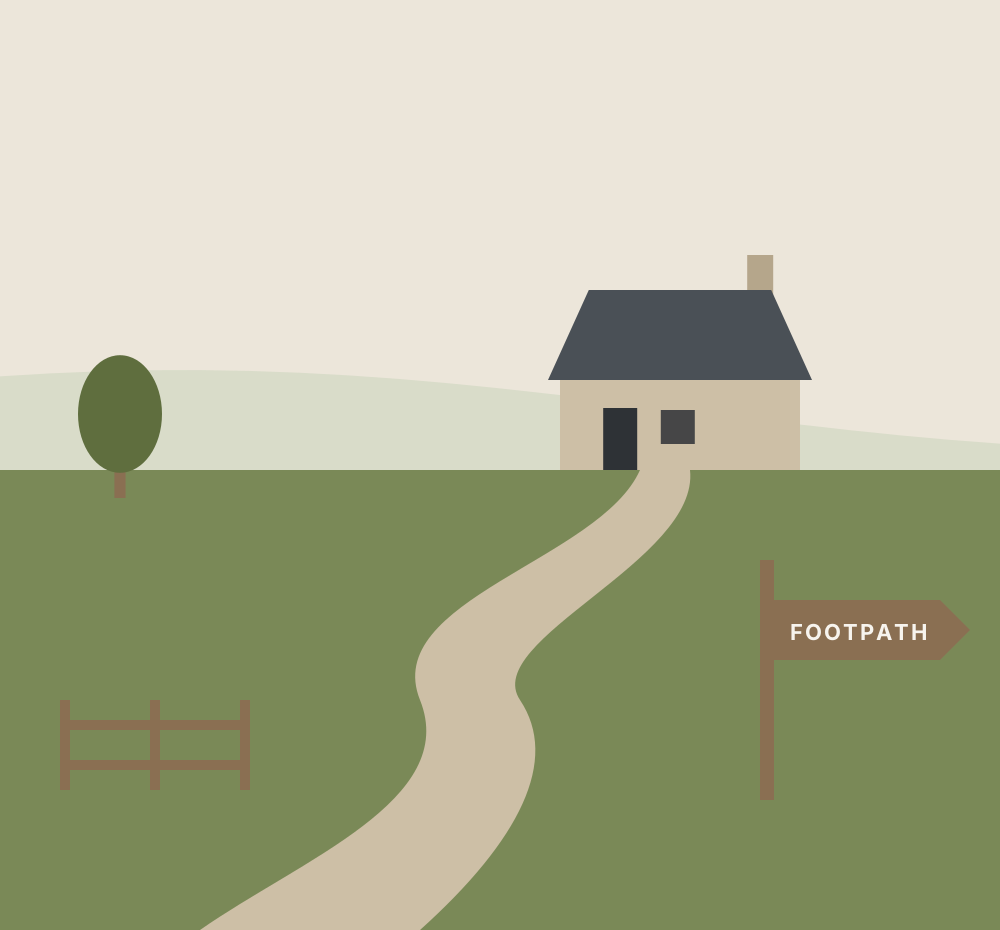
A long farm track may cross land the house doesn't own. Your solicitor should confirm that the property has a legal right of way, for vehicles as well as on foot, and who pays to maintain the track. Public footpaths or bridleways across the garden or fields are common in walking country; check the council's definitive map before you fall for the view.
Boundaries and unregistered land
Older rural properties are more likely to be unregistered at HM Land Registry, or to have boundaries that don't match what's on the ground. Neither is a reason to walk away, but both take time to resolve. Walk the boundaries with the plan, ask about any fields, woods or streams included, and expect your solicitor to need more deeds and searches than for a modern home.
Flood risk
A river view can come with river levels, and both the Usk and the Wye are known to flood. In Wales, Natural Resources Wales publishes flood risk maps showing whether a property is at risk from rivers, the sea or surface water. In England, the Environment Agency's long-term flood risk service does the same job.
Ask the sellers directly whether the house, garden or access track has ever flooded, and whether they have made an insurance claim. Then get a buildings insurance quote before you exchange contracts, not after, because a property that is hard to insure will also be hard to mortgage and, one day, hard to sell.
Occupancy and planning conditions
Some rural homes carry an agricultural occupancy condition, limiting who can live there to people working, or last working, in farming or forestry. Others, particularly barn conversions, may be restricted to holiday use. These conditions affect who can buy, what lenders will lend, and what the property is worth. Your solicitor's planning searches should reveal them, but ask early.
Old buildings: listing, surveys and materials
Listed buildings: Many character homes here are listed for their architectural or historic interest: by Cadw in Wales, or Historic England across the border. Listing covers the whole building, inside and out, and often its outbuildings. You will need listed building consent for most alterations, even replacing windows or changing internal walls, and carrying out works without consent is a criminal offence. Before you buy, ask what work the current owners have done and whether consent was obtained since a buyer can inherit the problem.
Conservation areas: Usk, Monmouth, Tintern and many of the surrounding villages include conservation areas. Within them, demolition and some extensions need planning permission, permitted development rights are more limited, and you must usually give the council notice before cutting back or felling trees. None of this should put you off, but it does mean checking early what you could and couldn't change.
Get the right survey: For any older or altered home, choose a full building survey (RICS Level 3) rather than a basic report, ideally from a surveyor who knows traditional buildings and who will therefore look closely at roofs, timbers, damp, drainage and any past structural movement.
Respect the materials: Old stone houses were built to breathe. Cement render, plastic paints and modern damp-proofing can trap moisture and cause the damp they claim to cure. Lime mortar, lime plaster and good ventilation are usually the answer. A surveyor who recommends injecting a chemical damp course into a 300-year-old stone wall may not be the right surveyor.
Running costs: Thick walls stay cool in summer but take a lot of heating. Ask for recent energy bills, check the Energy Performance Certificate (bearing in mind that EPCs often misjudge older buildings), and find out whether the home runs on oil, LPG, a heat pump or wood.
Planning, phosphates and protected landscapes
If you plan to extend, convert outbuildings or add a holiday let, read this section twice.
Phosphates: The Usk and the Wye are both protected Special Areas of Conservation, and both are failing their targets for phosphorus. NRW's assessment found 88% of the Usk's water bodies and 67% of the Wye's failing (Monmouthshire County Council). As a result, under the Habitats Regulations, planning authorities must consider the phosphorus impact of new development within these catchments (NRW).
In practice, any proposal that adds wastewater, such as a new dwelling, an annexe, or a barn converted to a home or holiday let, may need to show it won't add phosphorus to the river, often through mitigation. NRW updated its advice in February 2026, and a Welsh Government nutrient budget calculator now helps assess the impact of new development (Bannau Brycheiniog NPA). Buying a house is unaffected, but expanding it may not be. If a property's value depends on development potential, speak to a planning consultant before you offer.
Barn conversions are different in Wales: England has a permitted development right ("Class Q") that lets some farm buildings become homes without a full planning application. Wales has no equivalent, so converting a barn in Wales generally needs full planning permission.
Protected landscapes: Much of the lower Wye lies within the Wye Valley National Landscape, the area formerly known as an Area of Outstanding Natural Beauty. Planning authorities must give great weight to conserving its natural beauty, so expect careful scrutiny of extensions, new outbuildings, external lighting and anything that would be visible across the valley. Thoughtful, well-designed proposals are often approved, but it pays to involve an architect who knows the area from the outset.
Money: tax, council tax and mortgages
Purchase tax depends on the side of the border: If you buy in Wales, you pay Land Transaction Tax (LTT) to the Welsh Revenue Authority. If you buy in England, you pay Stamp Duty Land Tax (SDLT) to HMRC. The two taxes have different bands and reliefs, so the same price can produce a different bill. For a main home in Wales, no LTT is due on the first £225,000, but unlike England, Wales offers no first-time buyer relief (SalaryTax). England's starting threshold is lower, although first-time buyers there benefit from relief. The Welsh Government has kept LTT rates and thresholds unchanged for 2026–27 (Ross Martin).
If you will own more than one home when you buy, higher rates usually apply on both sides of the border, and the Welsh higher rates rose in December 2024. Rules on refunds and exceptions are detailed. Use the official calculators (the Welsh Revenue Authority's for LTT, HMRC's for SDLT) and always take advice from a tax adviser on your own circumstances.
Second homes and council tax: Welsh councils can charge a premium on second homes. Monmouthshire charges a 100% premium, doubling the bill (Monmouthshire County Council). If you're buying a weekend retreat, budget for it.
Mortgages for unusual homes: Many lenders are cautious about homes that fall outside their standard criteria. That includes non-standard construction such as timber frame, thatch or cob, homes with significant land or several outbuildings, properties with an agricultural occupancy condition, private drainage that needs work, and barn conversions restricted to holiday use. A cautious lender may lend less, ask for a larger deposit or decline altogether.
The answer is to speak to a mortgage broker who understands rural property early, ideally before you make an offer, so that you know which lenders will consider the home and on what terms. Allow extra time for the valuation too, because valuers often need to visit, and sometimes revisit, properties that are hard to compare with others nearby.
The buying process, step by step
Wales and England share one legal system for buying property, so the process is the same on both banks of the Wye. What differs for rural homes is how much needs checking, so allow longer than for a town purchase.
-
Get your finance ready: Speak to a mortgage broker who knows rural property and get an agreement in principle before you view seriously.
-
Choose your solicitor early: Pick a conveyancer with rural experience: drainage, rights of way, unregistered land and agricultural land are their bread and butter.
-
View with purpose: Go twice. Look at the track, the drains, the boundaries and the neighbours, not just the kitchen.
-
Make your offer, subject to survey and contract: Agree what's included: land, outbuildings, fixtures and any machinery.
-
Commission the surveys: A building survey (RICS Level 3), a drainage survey and, for a private supply, a water test. Add specialist reports if the surveyor flags timber, structure or damp.
-
Let your solicitor investigate: Searches and enquiries will cover title, rights of way, planning history, flood risk and environmental matters. Expect more questions than for a town house.
-
Secure your mortgage offer: The lender's valuer will visit; unusual features can slow this down.
-
Exchange contracts: You're now committed. Arrange buildings insurance from exchange, not completion.
-
Complete and move in: Your solicitor will file the LTT or SDLT return and pay the tax.
Buyer's checklist
Run through this before you make an offer, and again before you exchange.
-
Which side of the border is it on: Wales (LTT) or England (SDLT)?
-
Mains drainage, or a private system? If private: registered with NRW (Wales), compliant, and serviced?
-
Mains water, or a private supply? Recent test results?
-
Legal right of way along the whole access, for vehicles?
-
Any public footpaths or bridleways across the land?
-
Registered title, and do the boundaries match the plan?
-
Flood history and an insurance quote?
-
Listed, or in a conservation area? Consents for past work?
-
Any agricultural occupancy or holiday-use conditions?
-
Plans to extend or convert? Phosphates and planning checked with a consultant?
-
Building survey (RICS Level 3) and drainage survey booked?
-
Lender happy with the construction, land and conditions?
-
Running costs, heating fuel and council tax (including any second-home premium) budgeted?
Sources
-
Register your septic tank or small sewage treatment plant, Natural Resources Wales
-
Running and maintaining a septic tank or small sewage plant, Natural Resources Wales
-
Advice to planning authorities on nutrient sensitive SACs, Natural Resources Wales
-
Phosphates briefing, Monmouthshire County Council
-
Nutrients and planning, Bannau Brycheiniog National Park Authority
-
Council tax and second homes, Monmouthshire County Council
-
Wales sets its 2026–27 budget, Ross Martin
-
Wales LTT calculator, SalaryTax