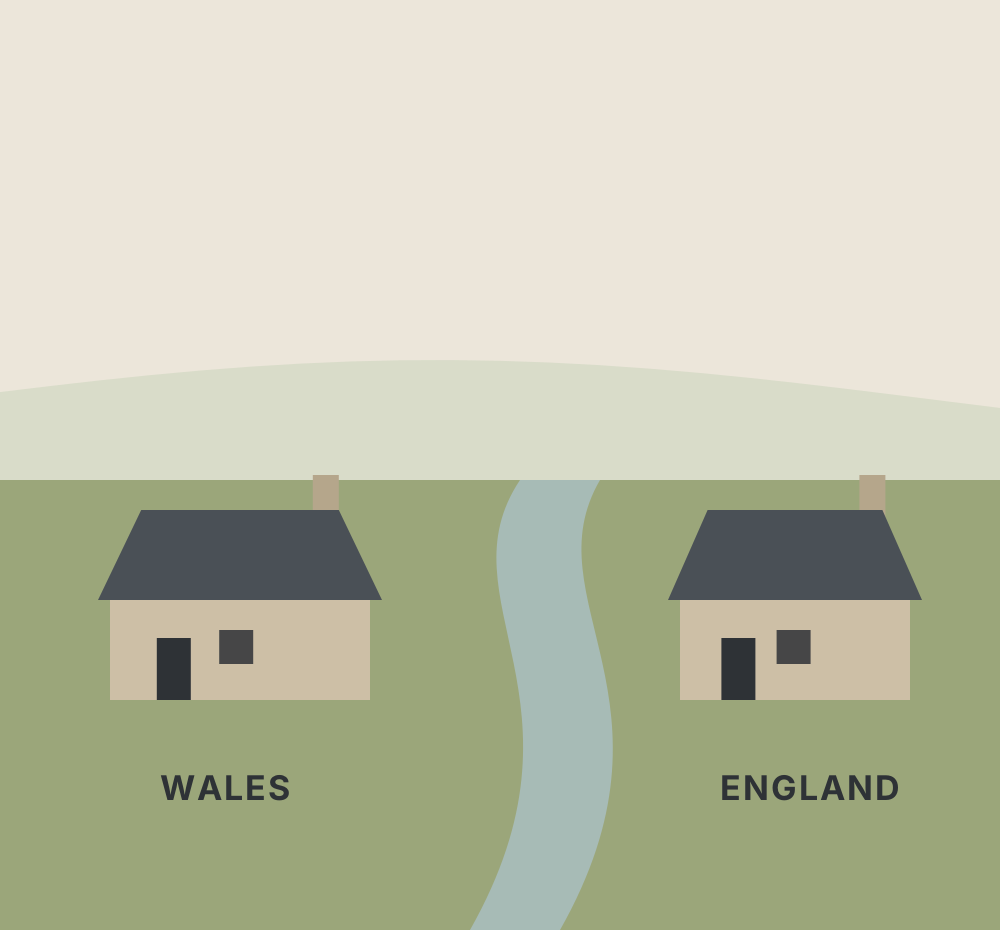
When you buy a home in this part of the world, the tax you pay can depend on which bank of the river it stands on. Homes in the Vale of Usk and on the Welsh side of the Wye are subject to Land Transaction Tax (LTT). Homes on the English bank, in Gloucestershire and Herefordshire, are subject to Stamp Duty Land Tax (SDLT). The two taxes work in a similar way, but their thresholds, rates and reliefs differ, so two homes at the same price, a mile apart, can produce noticeably different bills.
This guide explains how the two taxes work at a high level, so that you can budget sensibly and ask the right questions. It is not tax advice. Tax rules are detailed and change from time to time, and the right answer depends on your own circumstances, so always check the official calculators and take advice from a qualified tax adviser or your solicitor before you commit.
Land Transaction Tax in Wales
LTT replaced Stamp Duty in Wales in April 2018 and is collected by the Welsh Revenue Authority. Like Stamp Duty, it is charged in slices: you pay nothing on the portion of the price below the first threshold, then progressively higher rates on each slice above it.
The nil-rate band: For a main home, no LTT is payable on the first £225,000 of the price, and that applies to everyone (Moneysupermarket). Above that, the rates rise in steps as the price increases.
No first-time buyer relief: Unlike England, Wales does not offer a separate relief for first-time buyers. The higher £225,000 starting threshold is intended to help all buyers, including those buying their first home.
Stability for 2026–27: The Welsh Government has kept LTT rates and thresholds unchanged for 2026–27 (Ross Martin).
Stamp Duty Land Tax in England
Across the border, SDLT is collected by HMRC and also works in slices, but with a lower starting point.
The nil-rate band: For most buyers of a main home, the nil-rate threshold is £125,000. Above that, the standard rates rise in steps: 2% on the next slice up to £250,000, then 5% up to £925,000, with higher rates beyond (Futuramo). The threshold fell back to £125,000 in April 2025 after a temporary increase.
First-time buyer relief: First-time buyers in England pay no SDLT on the first £300,000 and 5% on the portion between £300,001 and £500,000. If the price is above £500,000, the relief is lost entirely and the standard rates apply to the whole price (Saracens Solicitors). To qualify, you and anyone buying with you must never have owned a home anywhere in the world.
What this means in practice: For a home mover buying a main home, Wales's higher starting threshold usually means a lower bill at modest prices. For a first-time buyer, England's relief can make the English side cheaper, up to a point. The crossover depends on the price and on who is buying, so run both calculators if you are looking on both sides of the river.
Higher rates for additional homes
Both countries charge more when a purchase is not your only home. If you will own more than one residential property at the end of the day you complete, for example because you are buying a holiday cottage, a buy-to-let or a home before your current one has sold, higher rates are likely to apply.
In Wales: A separate, higher set of LTT rates applies to additional homes from the first pound of the price. The Welsh Government increased these higher rates in December 2024, and they remain in place for 2026 (Menai Holidays).
In England: SDLT on additional homes carries a 5% surcharge on top of the standard rates on each slice of the price (Your Income Calculator). Buyers who are not UK resident pay a further 2% surcharge.
Replacing your main home: If you buy your new home before selling your old one, you may pay the higher rates at first and then be able to reclaim the difference if you sell your previous main home within the time allowed. The time limits and conditions differ between Wales and England, so ask your solicitor to explain them before you exchange, and diarise the deadline.
Council tax premiums on second homes
If you are buying a weekend retreat or a holiday home rather than a main home, council tax deserves a line in your budget too. Welsh councils can charge a premium of up to 300% on top of the standard council tax for second homes (Business News Wales). Monmouthshire has charged a 100% premium on second homes since April 2024, effectively doubling the bill (Monmouthshire County Council). English councils can also charge premiums on second homes, so check the policy of the relevant council on the English bank as well.
Returns, deadlines and getting advice
Who files the return: Your solicitor or conveyancer will normally complete and file the tax return and pay the tax on your behalf, using funds you provide before completion. Make sure the money is in place well in advance.
Deadlines: In Wales, the LTT return and payment are due within 30 days of completion. In England, the SDLT deadline is shorter, at 14 days. Late returns attract penalties and interest.
Use the official calculators: The Welsh Revenue Authority publishes an LTT calculator on GOV.WALES, and HMRC publishes an SDLT calculator on GOV.UK. Use them as a starting point, but remember that they only work if the information you enter is right.
Take advice: Tax on property purchases can become complicated quickly: buying with land or outbuildings, buying more than one dwelling, mixed residential and commercial use, buying through a company, or buying with someone who already owns a home. In any of those situations, take advice from a qualified tax adviser before you commit. This guide is designed to help you have that conversation, not to replace it.
Sources
-
Stamp duty and LTT explained, Moneysupermarket
-
Wales sets its 2026–27 budget, Ross Martin
-
Stamp duty in 2026 explained, Futuramo
-
Stamp Duty in 2026, Saracens Solicitors
-
Second home LTT in Wales, Menai Holidays
-
UK stamp duty 2026 guide, Your Income Calculator
-
Council tax premium consultation, Business News Wales
-
Council tax and second homes, Monmouthshire County Council